

Do you need a better way to manage your budget?
Maybe you’re looking for a way to automate some of your tedious tasks.
Corporate Performance Management (CPM) software has the power to change every aspect of your financial operations.
What is CPM software? Corporate Performance Management software is a comprehensive solution that helps you manage all of your budgeting and finance activities. With CPM software, you can automate repetitive or complex tasks, streamline your operations and boost productivity.
So, how does Prophix do it differently? With Prophix, you can:
- Streamline Budget Management
- Automate Repetitive Processes
- Integrate Data Directly from the Source
- Access Real-Time, Data Points
- Create Comprehensive, Insightful Forecasts
- Simplify Consolidation and Close
- Conduct Complex Data Analyse
And so much more!
The Why and How of CPM
Natural disasters, a pandemic, and global protests have put businesses to the test this year. Now, more than ever, organizations need to be able to weather the economic downturns caused by these disruptions.
To navigate these uncertain times, resilient companies use scenario planning. A comprehensive scenario plan enables organizations to pivot and make better financial decisions regarding future operations.
This blog will detail the benefits and best practices of scenario planning. It will also explore how to leverage innovative tools to improve the scenario planning process.
What is Scenario Planning?
Also known as “what-if analysis,” scenario planning uses current data and assumptions to consider multiple, potential outcomes. The definition of scenario planning is “a set of assumptions on what the future is going to be and how your business environment will change over time in light of that future.”
A scenario plan can help you explore different narratives to determine how to best support future business operations. By assessing how variables will interact under distinct conditions, you can identify which variable will have the biggest impact on your financial plans. These variables can include the pricing of products, operational expenses, market fluctuations, and more.
All industries, including public, private, not-for-profit, and government sectors apply scenario planning as part of their financial planning and analysis. C-suite executives, senior finance management, and financial analysts are typically the individuals who lead the scenario planning efforts at their organisation.

Benefits of Scenario Planning
Without proactive scenario planning, many companies will struggle to weather the storm. This is evident from the many businesses filing for bankruptcy in 2020 such as 24 Hour Fitness, Hertz, JCPenny, and more.
Scenario planning is an important part of a company’s risk management process. It’s essential for agile organisations to have a scenario plan in place to:
- Adequately prepare for unforeseen financial circumstances
- Create better pivot plans to respond to disruption
- Answer financial questions quicker and with increased confidence
- Increase shareholder confidence with plans that consider risk mitigation
What is Scenario Planning Best Suited For?
Scenario planning is best suited to predicting the impact of large-scale changes or disruptions. Examples of major changes include:
- Financial crises
- Pandemics
- Labour disruptions
- Social unrest
- Criminal activity
Conversely, scenario planning can also help you better navigate unexpected success, such as explosive growth, or sudden increased demand for your products and services.
Businesses need a scenario plan during an economic downturn when it’s uncertain how market volatility will play out. During major disruptions, what’s worked before simply doesn’t cut it anymore. Historical trends are no longer good indicators of future performance.
Scenario planning should not be confused with sensitivity analysis. Sensitivity analysis only accounts for changes in a single variable, while keeping all others constant. To best predict the performance of multiple variables, you will need to use scenario planning to capture their impact.
Tools to Create a Scenario Plan
For effective scenario planning, you will need to identify relevant data and assumptions. For example, you may want to consider company-wide data, market intelligence, and historical events. Collecting company-wide data from your ERP, CRM, and HR systems can help you see the bigger picture. Keeping track of new competitors or innovations in the market will also help you better prepare. Keep in mind any historical events that have led to major shifts in your industry. If you can formalize the relationship between different data elements, then you can create a quantitative model.
A key challenge to scenario planning lies in an over-reliance on manual spreadsheets. Spreadsheets often have missing data, inconsistent formulas, and broken links. All these things can make the scenario planning process feel cumbersome and difficult to execute.
Many organisations will need to consolidate data from disparate systems. Trying to combine data from your ERP, CRM, and HR systems into a cohesive scenario plan can be quite the feat. With so many systems, financial analysts may struggle to find relevant data in a timely manner.
Businesses that are serious about scenario planning will need a dedicated tool. It is essential to invest in a tool that was created with scenario planning and analysis in mind.
Instead of traditional spreadsheet-based systems, innovative companies use cloud-based software to create scenario plans. Corporate Performance Management (CPM) software allows finance leaders to easily create scenario plans based on existing actual, budget, and forecast data without the headaches of massive spreadsheets.
In the 2020 CFO Benchmark Report, 72% of respondents said their organisations were ready for testing new technologies that would empower and enable their finance teams. By using CPM software, finance teams can access relevant data at any time, and easily manage resources to improve decision-making based on opportunities and risks.
How to Create A Scenario Plan Using Prophix
By leveraging CPM software, you can create robust and comprehensive scenario plans easily and quickly.
A. Gather model requirements and data
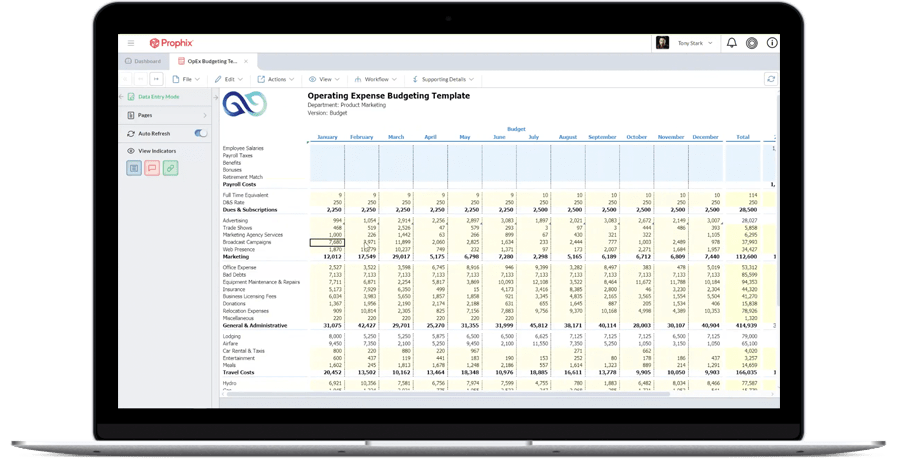
Prophix’s CPM software minimizes the time and effort needed for scenario planning. While spreadsheets can be error-prone, cloud-based CPM tools sync data from your ERP, CRM, and HR systems to ensure full validity. Through direct data integrations, you can easily organise information from various systems. By planning in a CPM tool like Prophix, you can quickly account for different outcomes and make informed decisions.
B. Determine the number of scenarios needed
For scenario planning to be effective, it’s important to outline various different scenarios. However, it’s also crucial to not have too many scenarios. An over-abundance of scenario plans can cause confusion.
To easily create effective scenarios, you can leverage Prophix’s Infoflex process. The Infoflex process transforms information using existing data or user-defined inputs. It can allocate data or increase data values by a percentage. Consider using Infoflex in these three scenarios as a basis for your planning process:
- Best case: Based on increased sales or a spike in demand. This could be due to sudden market changes or the introduction of new revenue lines. While this is a positive use case, the best case can still cause strain. You may need extra resources or headcount. You can target specific revenue accounts to increase with the Infoflex process.
- Base case: Deduces sales trends based on prior periods’ actuals. Prophix’s Infoflex process can read existing actuals to extrapolate. It can pre-populate future periods with projection data as a foundation for the base case. This scenario can highlights what you can do to change or maintain your current trajectory.
- Worst case: Assumes revenue or costs are challenging business continuity. This planning option often involves drastic changes to fixed and variable expenses. You can use Infoflex to target specific accounts for increases or decreases. Consider decreasing revenue accounts to align with current events and increasing expenses.
In times of market volatility, it’s beneficial to focus more on negative case scenarios. There is really no limit to the number of scenarios you can build. You can leverage responsive CPM models to create business plans that mimic economic forecasts. For example, you can have separate scenario plans that align with either V-shape or U-shape economic rebounds.
C. Distribution of scenario plan
For a plan to be relevant and timely, financial teams need to share it with their senior management.
One method to share data quickly and efficiently is to use Prophix’s Report Binders. This allows finance teams to group related reports and send them out to the C-suite. Report Binders enable easy distribution of key data straight to a user’s email inbox. You can group documents comparing each scenario into a single report binder.
To get an overview of your scenario plans, Prophix Dashboards offer intuitive visual analytics. These dashboards can illustrate different variables and scenarios. Prophix can pull together integrated data for a quick pulse on how the business is performing. This can include key metrics from your ERP, CRM, and HR systems. Users can view dashboards based on custom security settings. Senior managers can view a different dashboard than financial analysts. This allows for customized dashboards that show the right data to the right people.
Prophix’s cloud-based CPM software also leverages artificial intelligence to improve scenario analysis. The Chart Insights feature uses natural language processing to automatically create detailed narrations, which clearly explain any insights behind the displayed data.
By using a dedicated scenario planning tool like Prophix’s CPM software, finance teams can automate manual tasks. This saves time, enabling finance teams to focus on higher-value priorities, such as scenario analysis. CPM software also improves your analysis by ensuring you have access to the most current and accurate data. With better information at your fingertips, finance leaders are empowered to make better business decisions.
Conclusion
Scenario planning is a powerful exercise to reassess your organization’s financial health in both prosperous and challenging times. With the right tools, finance teams can quickly identify the key drivers, data, and assumptions needed to plan for a better future.
Prophix’s cloud-based CPM software empowers finance teams to scenario plan with ease. With these insights, finance professionals can make better business decisions and improve business resiliency, regardless of what the future holds.