

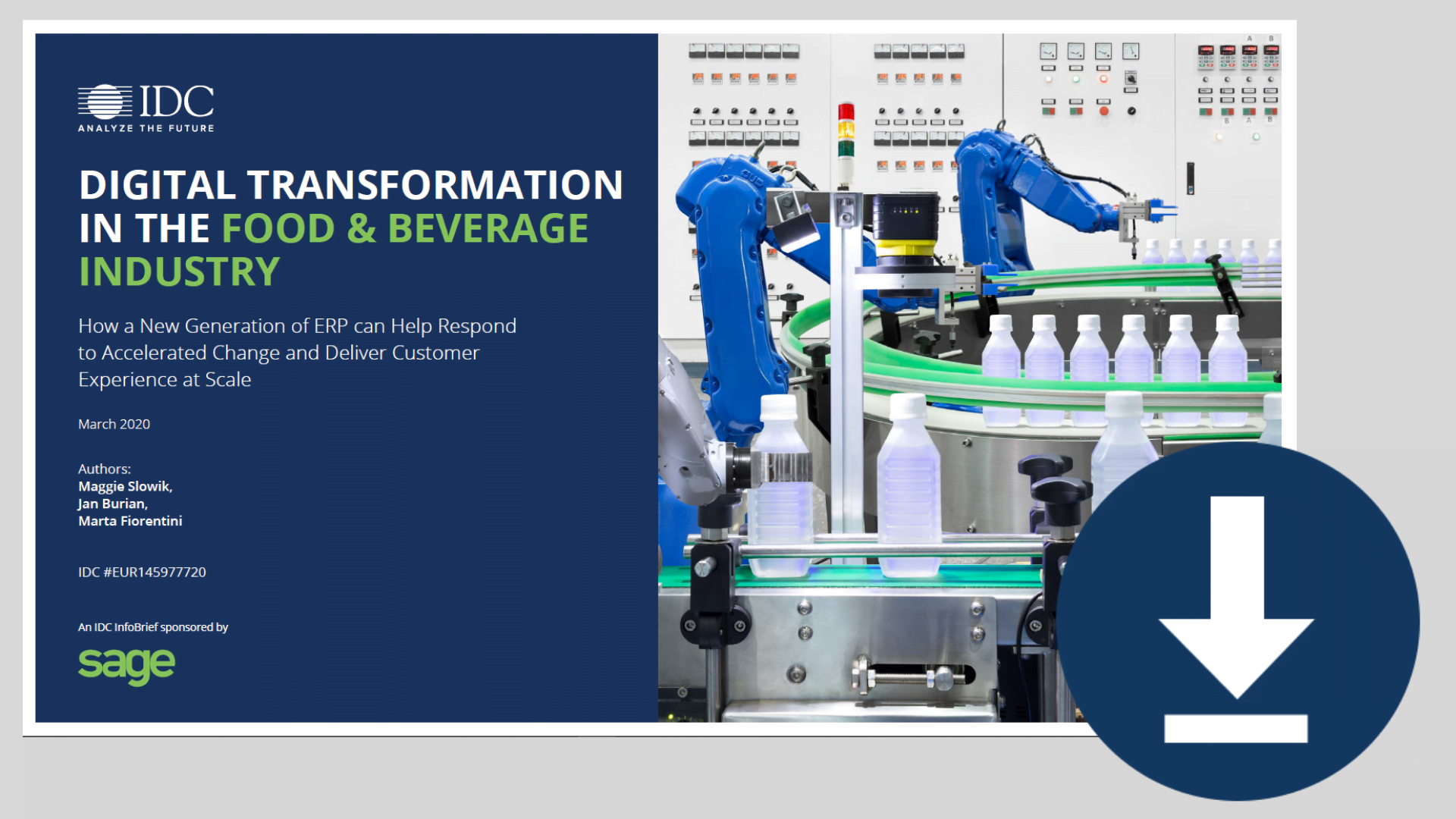
According to an IDC report reviewing digital transformation and ERP systems within the Food & Beverage industry, only 10% of respondents stated that their ERP is used the way it was intended.
This leaves 90% of businesses with an ERP system either not being used correctly or not fit for purpose, leading to “work arounds”.
To drill into this in more detail, the top 3 ERP weaknesses mentioned were:
- The system is transactional and does not offer “real time” information.
- It does not support the company’s growth strategy.
- It lacks collaborative features, and this hinders productivity.
The key take-aways here are that the ERP systems being used today do not help Food & Beverages operations tackle their business challenges due to lack of “real time” intelligence, siloed activity or information, and functional misalignment.
Challenges for the Food & Beverages Industry Today
The most notable challenges for F&B operations according to this report are:
- Minimising waste
- Reducing costs
- Minimising risks
- Accelerating compliance
- Increasing market agility
It is clear, on a superficial level, that the failures of legacy ERP systems are preventing the above objectives being achieved. We will look at how addressing these shortfalls can assist with the top five challenges.
Solutions Offered By Modern ERP
Firstly, “real time” information means different things to different businesses. Most operations do not require to-the-second latency of data for the majority of tasks, although in some cases it is relevant. For example, WIP (work in progress) costing doesn’t need to be accurate to the instant (2-3 times per day might be sufficient), whereas stock movements need to be immediate in order to ensure that sales are controlled and stock-outs are avoided or managed. There are operational challenges which preclude true real-time data, most typically those processes that require human intervention, and therefore, expectations must be tempered.
There is a combination of processes and reporting mechanisms that will come into play to enable “real-time” information and by virtue of this unlock many of the benefits of modern ERP:
- Operational automation
The autonomous processing of operational activity to reduce the points of manual intervention (e.g. intercompany back to back purchase & sales orders, stock movements etc.). Sage X3, being a natively multi-site & multi-company system, can support automation of this nature. The removal of manual (human) intervention is a key step in maximising the efficiency of the ERP system and modern ERPs, such as Sage X3, making use of full system integration to automate as much as is viable; allowing for straight-through processing of key business processes, such as from sales order to shipping, with minimal human intervention.
- Aligned processes with workflow notifications:
Enabling the smooth hand-to-hand processing of tasks that must be undertaken manually. Workflows with email notifications can play a key role here in avoiding delays, which thereby enables closer to “real time” data and increased operational efficiency. Using the Sage X3 workflow engine, and Mysoft’s enhancements around this, can significantly accelerate activity turnarounds and increase process visibility.
- Access tools:
In order to take advantage of this new “real-time” data, it must be accessed in “real-time” too, in an integrated and intuitive UI/UX. Interactive business intelligence (BI) and reporting solutions will assist with this at the level of reporting, and solutions such as Sage X3 have been developed (and undergo constant review and enhancement) to ensure that the end-to-end user experience is streamlined and as accessible as possible. In X3 we implement solutions such as Sage Enterprise Intelligence or Sage Data and Analytics to open up the possibilities of data management and “real-time” reporting, tailoring the ERP interface by each business role to maximize the efficiency of the system for end-users.
- Technology:
Aligned to the above point on access, there is a consideration for technology also. As the events of 2020 and 2021 have shown us, the working environment is no longer limited solely to the office, warehouse or factory. Being able to access business-critical systems remotely is not a “nice to have” but is now essential for ensuring business continuity – moving to a Cloud-native solution such as Sage X3 can provide business resilience to allow for seamless continuation of activity with a distributed workforce and market shocks.
For a Food and Beverage distributor or manufacturer, having “real-time” information in the system allows for more accurate FEFO (first expire first out) stock management and increased sales agility, which can contribute to resolving challenges around waste while enhancing compliance and traceability. When used in combination with integrated processes it will, as the IDC report notes, help with cost control, highlight inefficiencies and have an impact on consumer trust at a macro level. Access to “real-time” data and having a holistic view of a business allows for increased business agility; this enables an operation to pivot to new market opportunities and maximize growth potential.
The IDC report places modern, innovative, cloud-based ERPs at the heart of the business ecosystem; while not claiming that it is a panacea for all business requirements (there is still a case for some best-of-breed applications) the IDC report highlights ERP as a focal point for business systems and processes. Leveraging emerging technologies such as AI, blockchain, cloud, etc. can transform the relationships businesses have with their ERP, from a point of contention to a source of operational intelligence.
To learn more about how the future of ERP could affect your business, please read the IDC Report and contact us about our (and our customer’s) experiences.
Find out more: